Last updated November 17, 2026








Free written scope consultation - allowances, timeline, and change-order rules on paper before a single trade is scheduled
Bathroom Remodeling Maintenance Schedule: What to Do and When
Here’s the counterintuitive truth about protecting a new bathroom: the most important inspection happens 30 days after the last tile is set, not two years later when something looks wrong. That’s when the first cure shrinkage shows up in your caulk lines. A 15-minute re-caulk at the 30-day mark prevents the kind of slow leak that rots a subfloor and turns a $340 touch-up into a $2,000 repair. In our experience across Denton, the homeowners who skip that first check are the ones who call us back for water damage. This guide lays out the full calendar – 30 days, one year, five years – so your remodel holds its value.
Quick Answer
Inspect and re-caulk every wet-area joint 30 days after your bathroom remodel, then move to an annual routine of grout sealing, fixture descaling, and supply-line checks tied to Denton’s hard water. At the five-year mark, do a full re-caulk of the wet area and test your GFCI outlets. Document each task as you go so a workmanship guarantee has something to stand on if a failure ever shows up.
Styles & brands we work with
- Kitchen remodeling
- Bathroom remodeling
- Home additions & ADU
- Roofing
- Windows & doors
- Driveway & pavers
- Fence
Table of Contents
- Why a Bathroom Needs a Maintenance Calendar at All
- The 30-Day Post-Remodel Checklist
- Annual Maintenance: Denton’s Hard Water Sets the Pace
- What the 5-Year Inspection Covers
- Material-Specific Care: Porcelain, Natural Stone, Large-Format
- How to Document Maintenance to Support a Warranty Claim
- Common Mistakes to Avoid
- When to Call a Professional
Why a Bathroom Needs a Maintenance Calendar at All
A bathroom is the hardest-working room in the house. It cycles through heat and moisture every single day, and the materials that make it look finished – caulk, grout, sealant – are the ones doing the quiet work of keeping water where it belongs. None of them last forever. A maintenance calendar treats those wear parts like what they are: parts.
Denton makes this more urgent than most places. Our water runs hard, heavy with dissolved minerals that leave scale on showerheads and etch glass within months. Summer humidity climbs and the air conditioner runs hard, so the bathroom swings between damp and dry. That swing is what works caulk joints loose and opens hairline cracks in grout. In neighborhoods like Robson Ranch and the older homes near the Denton square, we see the same pattern: showers that look pristine at year three but have a soft spot behind the tile because a caulk line failed quietly at month eight.
The calendar also protects your money. A bathroom is one of the higher-return remodels a homeowner can do, and water damage is the fastest way to erase that return. Fifteen minutes in month one is cheaper than a subfloor rebuild in year five, every time.
The 30-Day Post-Remodel Checklist
The first month is when new materials settle. Caulk shrinks as it cures, grout finishes its initial cure, and fixtures see their first real use. Run this checklist at the 30-day mark. It’s the single most valuable maintenance window you’ll have.
- Inspect every caulk line. Run a fingertip along the tub deck, shower pan, and where the backsplash meets the counter. Look for gaps, pulls, or a line that has gone from smooth to cracked. Any gap at 30 days means water has a path.
- Verify grout cure. Grout should be hard and uniform. Check for pinholes, crumbly spots, or color shifts that signal it didn’t cure evenly. Small voids get filled now, not after they collect water.
- Test the exhaust fan. Hold a tissue to the grille on high. It should pull the tissue tight and clear the mirror within a few minutes. A weak fan lets moisture linger and shortens the life of everything else in the room.
- Operate every supply valve. Open and close the shutoffs under the sink and behind the toilet once. Valves that sit untouched for years seize up; exercising them at 30 days keeps them working when you need them.
- Re-seal if the schedule calls for it. Some grouts and stone need their first sealer refresh within the first couple of months. Check your material paperwork.
Bradford Remodeling Co Denton stands behind every install with the Bathroom Remodeling in Denton program, and the 365-Day Done Right Promise covers workmanship for a full year. If a caulk line fails inside that window from how it was installed, we come back and correct it at no charge. But the 30-day check is yours to run, and it’s the difference between a minor touch-up and a repair.
Annual Maintenance: Denton’s Hard Water Sets the Pace
Once a year, spend an afternoon on the tasks that keep Denton’s water from eating your fixtures. Hard water is the main adversary here. It leaves mineral scale on everything it touches and, over time, clogs aerators and showerheads until flow drops to a trickle.
- Re-seal grout in the wet areas. A water-bead test tells you if sealer is still working: drip water on the grout, and if it beads, you’re good; if it soaks in, re-seal. Cementitious grout in a shower typically wants re-sealing once a year in Denton.
- Descale the showerhead and faucet aerators. Soak them in vinegar to dissolve the mineral layer, then scrub. Hard-water buildup also narrows the aerator screen and drops your water pressure.
- Inspect supply lines. Braided steel lines under the sink and behind the toilet should be checked for fraying, bulging, or corrosion at the fittings. They’re cheap to replace and disastrous to ignore.
- Check the exhaust fan again and clean the grille. Dust on the blades cuts airflow. Wipe it down and confirm the pull is still strong.
- Look at the toilet base and tank. A wobble or a faint water stain at the base can mean a failing wax ring. Catch it now.
If you want the full set of surface and fixture care steps that fit your specific materials, our General Contractor in Denton team can point you to the right products for what was actually installed. We don’t guess at specs; we work from the manufacturer’s documentation that came with the job.
What the 5-Year Inspection Covers
At the five-year mark, the bathroom has been through enough moisture cycles that the wear parts need a full reset. This is the deeper inspection – the one that catches problems before they’re expensive.
- Re-caulk the entire wet area. Not just the tub deck this time. Every joint in the shower, around the pan, at the wall-to-floor transition, and behind the toilet. Old caulk peels out and gets replaced with a fresh, mold-resistant bead.
- Check for tile lippage change. Run your hand across the floor and walls. If a tile edge that used to sit flush now catches your palm, the substrate beneath it may be moving. That’s a signal worth taking seriously – it points to moisture or a settling issue, not just a loose tile.
- Test every GFCI outlet. Press the test button, confirm it trips, then reset. Bathroom outlets near water are required to be GFCI-protected, and a failed unit is a safety issue.
- Inspect grout joints closely. Re-grout any joint that has cracked or hollowed. Cracks in a shower are where water gets behind the tile.
- Confirm the exhaust fan still moves enough air. Fans lose efficiency as they age. If the pull has weakened, a replacement fan is far cheaper than moisture damage.
A five-year inspection is also the natural time to plan your next surface refresh, and our Kitchen Remodeling in Denton crew often gets called in alongside it when homeowners decide to update the room next door at the same time.
Material-Specific Care: Porcelain, Natural Stone, Large-Format
Not all tile behaves the same way. The sealing frequency and cleaning products that work on one surface can damage another. This is where the details matter, and where getting it wrong costs real money.
Porcelain tile
Porcelain is dense and nearly non-porous, so the tile itself needs little care. The grout joints are the vulnerable part. With standard cementitious grout and narrow joints, seal annually. Wider joints hold more grout and more water, so they want the same yearly schedule but a heavier application.
Natural stone
Marble, travertine, and slate are porous and react to acids. They need sealing more often – sometimes twice a year in a shower – and they should never see vinegar or harsh cleaners, which etch the surface. A pH-neutral stone cleaner is the only thing that touches them.
Large-format tile
Large-format tile has fewer grout lines, which looks clean and modern, but the joints that do exist are wider and take more stress from movement. Sealing frequency is similar to porcelain, but pay closer attention to the perimeter and floor joints – that’s where lippage and cracks tend to show first.
Whatever the material, the rule is the same: match the sealer and the cleaner to the surface, not to habit. Our Bradford Remodeling Co Denton home page lists the name-brand materials we install, so you always know exactly what’s in your room and how to care for it.
How to Document Maintenance to Support a Warranty Claim
A workmanship guarantee is only as strong as the record behind it. When a homeowner asks us to honor a claim, the questions are practical: what failed, when, and what maintenance was done? If you’ve kept a simple log, those answers come easy.
Here’s what a contractor actually needs to see:
- Dates and tasks. A short written log – even a note on your phone – of when you re-caulked, re-sealed grout, or replaced a supply line.
- Photos. A phone photo of the caulk line at install and one at each check tells the story better than any description.
- Product records. Which sealer, which caulk, which cleaner. Some failures trace back to an incompatible product, and knowing what was used rules that out.
- A clear description of the failure. Where it is, when you first noticed it, and how it has changed.
Our 365-Day Done Right Promise covers workmanship for a full year from completion; if the work fails inside that window, we return and correct it at no charge. A documented maintenance log is what keeps a claim clean and a guarantee meaningful. We put every promise in writing before a tool comes out, and we expect the same discipline from a maintenance record.
Common Mistakes to Avoid
- Skipping the 30-day caulk check. This is the most expensive small mistake. That’s when cure shrinkage first shows, and a 15-minute re-caulk beats a $2,000 subfloor repair every time.
- Using vinegar on natural stone. It’s fine on porcelain but etches marble, travertine, and limestone. Denton’s hard-water scale tempts people to reach for the strongest cleaner, and on stone that’s the wrong call.
- Sealing grout on a guess. Sealing over damp grout traps moisture and can cloud the finish. Wait for a full cure and run the water-bead test first.
- Ignoring a soft spot in the floor. A spongy patch near a shower pan is a water problem, not a cosmetic one. Waiting makes it worse and more expensive.
- Never exercising the supply valves. Valves that sit shut for years can seize, and the time you discover it is the time you need to shut the water off fast.
- Letting the exhaust fan run dirty. A dust-clogged fan moves less air. In a Denton summer, that’s moisture staying in the room longer than it should.
- No records at all. Without a maintenance log, a legitimate warranty claim gets hard to prove. Document as you go.
When to Call a Professional
Plenty of this schedule is homeowner work – dusting a fan grille, descaling an aerator, running a water-bead test. But some issues need a trained eye before they turn into real damage. Call us when you spot tile lippage that’s changed since install, a soft or spongy floor near the shower, water staining at the base of a wall or toilet, a GFCI that won’t reset, or grout that keeps cracking after a re-seal. Those signal problems beneath the surface that no amount of caulk will fix. Electrical work behind a GFCI outlet and anything involving a wet substrate should go to a professional, both for safety and for your guarantee.
Bradford Remodeling Co Denton offers free estimates in Denton – call (844) 651-3175 to schedule yours. We answer with a live person, give you a written price before any work starts, and stand behind the result with a full-year guarantee.
See the difference
 Before
 After
 Before
 After
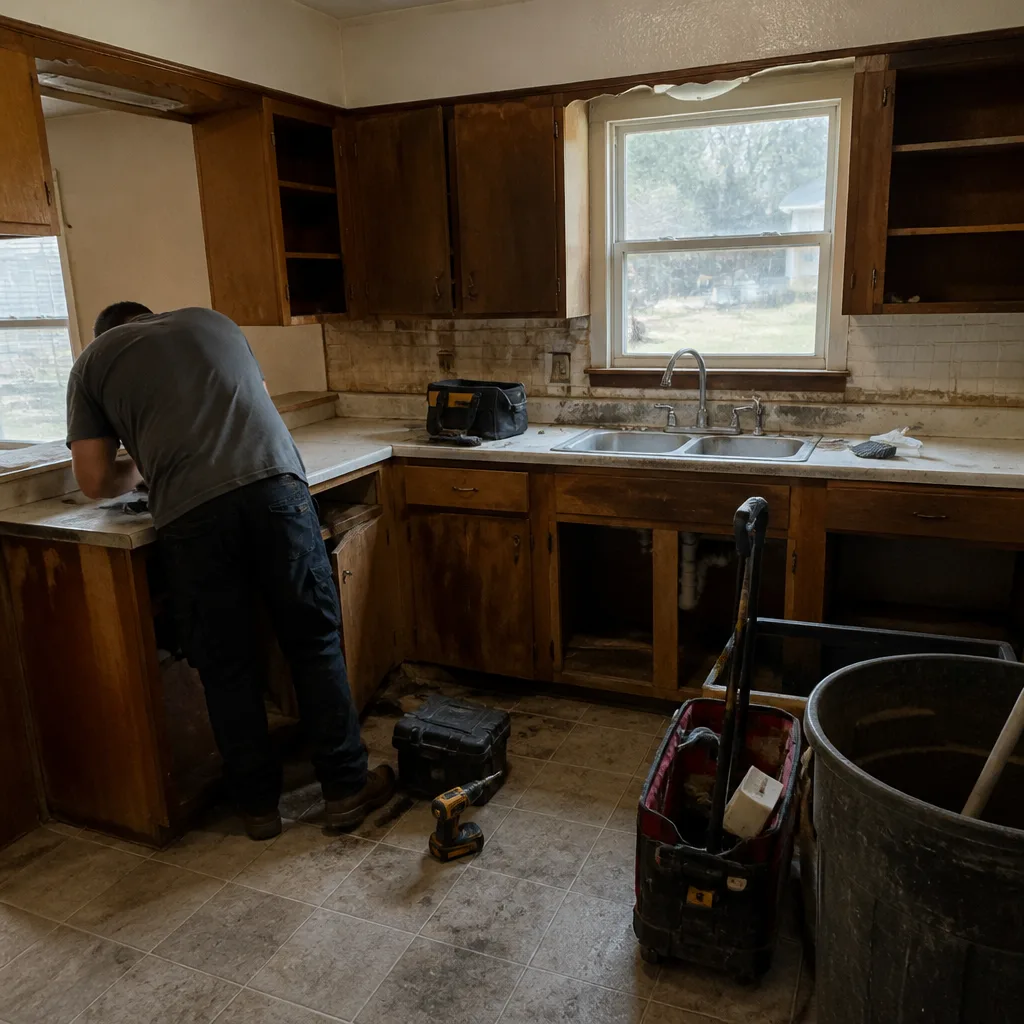 Before
 After
Frequently Asked Questions
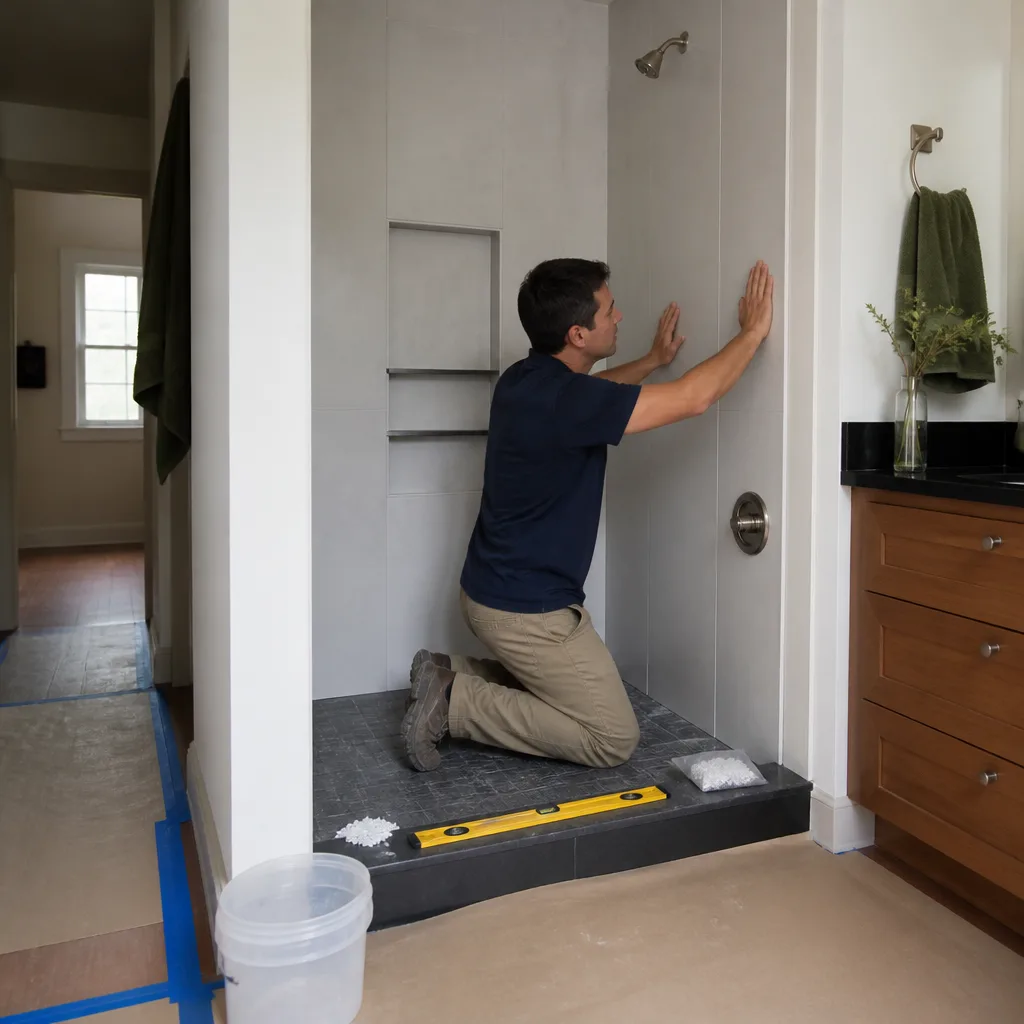
Inspect the caulk lines at 30 days after installation. That’s when the first cure shrinkage shows up, so a quick re-caulk then prevents water from getting behind the tile later. Call (844) 651-3175 for a free estimate if you’d rather have us check it.
Most cementitious grout in a Denton shower wants re-sealing once a year because of the hard water. Natural stone surfaces may need it twice a year. Run the water-bead test first – if water beads, the sealer is still working. Call (844) 651-3175 for an exact quote on re-sealing.
No. We give you a written price before any work begins, and the number doesn’t move at the door. That’s the Garrison Standard, and it’s non-negotiable. Call (844) 651-3175 to schedule your free estimate.
It covers a full re-caulk of the wet area, a check for any tile lippage change that signals substrate movement, a test of every GFCI outlet, a close look at grout joints, and a check on the exhaust fan. It’s the deeper look that catches problems before they get expensive. Call (844) 651-3175 to book one.
Yes, when permits are required for the scope, we pull them and the inspection gets passed before we call the job done. Documentation comes with the work. Call (844) 651-3175 to talk through what your project needs.
Keep a simple maintenance log with dates, tasks, photos, and the products you used. That record is what a workmanship claim stands on. Our 365-Day Done Right Promise covers the work for a full year, and we correct any failure inside that window at no charge. Call (844) 651-3175 if you have a guarantee question.
The Bottom Line
A remodeled bathroom runs on a simple calendar: a 30-day caulk and cure check, an annual routine built around Denton’s hard water, and a full reset at five years. The 30-day inspection is the one that matters most – a quick re-caulk then heads off the subfloor repair later. Match your care to your material, keep a documented log so your guarantee has teeth, and call a professional the moment a soft spot or tile lippage shows up. Do that, and the investment holds for years.
Written by the team at Bradford Remodeling Co Denton.